

Updated September 2026
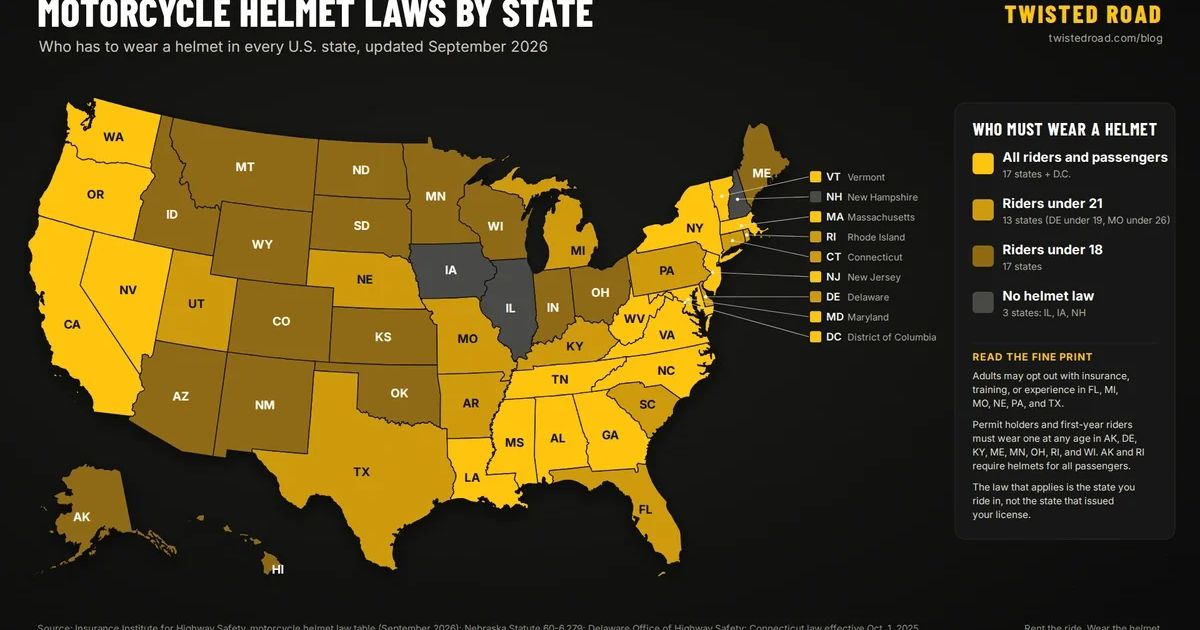
Motorcycle helmet laws in the United States fall into three groups. As of September 2026, 17 states and Washington, D.C., require every rider and passenger to wear a helmet; 30 states require helmets only for certain riders (most often those under 18 or under 21); and three states have no helmet law at all. Those three are Illinois, Iowa, and New Hampshire.
This guide breaks down every state, what changed over the last two years, and what it means when you rent a motorcycle and ride across state lines.
Helmet laws matter more to renters than most riders realize. The law that applies is the law of the state you're riding in, not the state that issued your license. A rider from New Hampshire who picks up a bike in Massachusetts is under a universal helmet law the moment the wheels roll. Twisted Road's helmet requirement policy requires all riders to comply with local, state, and federal helmet laws, so knowing the rules before you book is part of the ride.
Why Are Helmet Laws So Different Across the U.S.?
Helmet laws differ because Congress stopped enforcing them in 1976 and handed the decision back to the states. The Highway Safety Act of 1966 gave the federal government leverage over state traffic laws, and Washington used it to require universal helmet laws as a condition for certain safety and highway construction funds. It worked. By 1975, all but three states had a universal helmet law, according to the Insurance Institute for Highway Safety.
In 1976, Congress revoked the federal government's authority to penalize states that didn't comply. Within a few years, roughly half the states repealed or weakened their laws. That back-and-forth has continued for five decades, with some states loosening rules (Florida in 2000, Michigan in 2012, Missouri in 2020, Nebraska in 2024) while others tighten them (Delaware in 2023, Connecticut in 2025). The result is a patchwork built on one recurring argument: personal freedom versus public cost.
What Changed in 2024, 2025, and 2026?
Three states changed their helmet laws since this article first ran, and one high-profile repeal attempt failed. Nebraska dropped its universal law, Connecticut raised its helmet age, and Delaware added a rule for new riders. Here's what each change means for you.
-
Nebraska (effective January 1, 2024). Riders 21 and older with a Nebraska Class M license can ride without a helmet if they've completed an approved motorcycle safety course and filed proof with the DMV. A 2024 amendment (LB1004) extended the exemption to out-of-state riders 21 and older and let passengers 21 and older go helmetless when the operator qualifies. Everyone still needs eye protection under Nebraska Statute 60-6,279.
-
Delaware (effective September 1, 2023). Anyone who earns a new motorcycle endorsement must wear a helmet and eye protection for two years, and so must their passengers. Riders under 19 must wear one regardless, and every other rider must still carry a helmet on the bike, according to the Delaware Office of Highway Safety.
-
Connecticut (effective October 1, 2025). The helmet age rose from under 18 to under 21, as reported by NBC Connecticut. Riders 21 and older can still choose.
-
Maryland (2026 session). A bill to exempt riders 21 and older who have two years of licensure or a safety course, SB 195, never received a committee vote. Maryland's universal law stands.
The research moved too. A March 2026 study in the Journal of the American College of Surgeons found Michigan's 2012 repeal was linked to a 26 percent increase in average inpatient costs per crash patient compared with neighboring states that kept their laws. Expect that figure to show up in the next round of repeal debates. More bills are coming, not fewer.

Which States Have Universal Helmet Laws?
Seventeen states and Washington, D.C. require every motorcycle rider and passenger to wear a helmet, no matter their age or experience. The IIHS motorcycle helmet law table, updated September 2026, lists them as follows.
-
Alabama
-
California
-
District of Columbia
-
Georgia
-
Louisiana
-
Maryland
-
Massachusetts
-
Mississippi
-
Nevada
-
New Jersey
-
New York
-
North Carolina
-
Oregon
-
Tennessee
-
Vermont
-
Virginia
-
Washington
-
West Virginia
A few of these states carve out low-speed exceptions. Georgia and Vermont exempt mopeds and motor-driven cycles of 50cc or less, and New York exempts limited-use motorcycles capped at 20 mph. None of those exceptions apply to anything you'd rent on Twisted Road, so if you're picking up a bike in Los Angeles or New Orleans, plan on a helmet for every mile.
Which States Have Age-Specific Helmet Laws?
Thirty states require helmets only for younger riders, new riders, or both, and several let adults opt out if they carry medical insurance or complete a safety course. The most common cutoff is 18, followed by 21. The table below reflects the IIHS table as of September 2026 plus the state sources linked above.
|
State |
Who must wear a helmet |
Exemptions and notes |
|---|---|---|
|
Alaska |
Riders 17 and younger, instructional permit holders, and all passengers |
Passengers of any age must wear one |
|
Arizona |
Riders 17 and younger |
Mopeds 50cc or less exempt |
|
Arkansas |
Riders 20 and younger |
None |
|
Colorado |
Riders and passengers 17 and younger |
None |
|
Connecticut |
Riders 20 and younger |
Raised from under 18 on October 1, 2025 |
|
Delaware |
Riders 18 and younger, plus all riders for two years after a new endorsement |
Riders 19 and older must carry a helmet and wear eye protection |
|
Florida |
Riders 20 and younger |
Riders 21 and older may go without if they carry at least $10,000 in medical insurance. Mopeds 50cc or less exempt |
|
Hawaii |
Riders 17 and younger |
None |
|
Idaho |
Riders 17 and younger |
Mopeds 50cc or less exempt |
|
Indiana |
Riders 17 and younger |
None |
|
Kansas |
Riders 17 and younger |
None |
|
Kentucky |
Riders 20 and younger, instructional permit holders, and riders licensed less than one year |
None |
|
Maine |
Riders 17 and younger, permit holders, and first-year operators |
Motorized bicycles exempt |
|
Michigan |
Riders 20 and younger |
Riders 21 and older may go without with $20,000 in medical insurance plus either two years of endorsement or a safety course |
|
Minnesota |
Riders 17 and younger and instructional permit holders |
None |
|
Missouri |
Riders 25 and younger |
Riders 26 and older may go without if they carry health insurance (proof of financial responsibility) |
|
Montana |
Riders 17 and younger |
None |
|
Nebraska |
Riders 20 and younger |
Riders 21 and older exempt after an approved safety course (Nebraska Class M) or with an out-of-state license. Passengers 21 and older exempt when the operator is. Eye protection required for everyone |
|
New Mexico |
Riders 17 and younger |
Mopeds under 50cc exempt |
|
North Dakota |
Riders 17 and younger |
Passengers must wear one when the operator is required to |
|
Ohio |
Riders 17 and younger and first-year licensed operators |
Passengers of covered operators must also wear one |
|
Oklahoma |
Riders 17 and younger |
Motor-driven cycles and mopeds exempt |
|
Pennsylvania |
Riders 20 and younger |
Riders 21 and older exempt with two years of riding experience or an approved safety course |
|
Rhode Island |
Riders 20 and younger, all passengers, and first-year operators |
None |
|
South Carolina |
Riders 20 and younger |
Three-wheel motorcycles exempt |
|
South Dakota |
Riders 17 and younger |
None |
|
Texas |
Riders 20 and younger |
Riders 21 and older exempt with an approved safety course or medical insurance |
|
Utah |
Riders 20 and younger |
None |
|
Wisconsin |
Riders 17 and younger and instructional permit holders |
Mopeds exempt |
|
Wyoming |
Riders 17 and younger |
Mopeds 50cc or less exempt |
Two patterns are worth memorizing. Six states (Florida, Michigan, Missouri, Nebraska, Pennsylvania, and Texas) let adults ride without a helmet only after meeting an insurance, training, or experience condition, and police can ask for proof. Another group (Alaska, Delaware, Kentucky, Maine, Minnesota, Ohio, Rhode Island, and Wisconsin) covers permit holders or first-year riders regardless of age, catching many adults who assume the law applies only to teenagers.
Renters should read the passenger rules closely. Alaska and Rhode Island require helmets for all passengers, and Colorado, Nebraska, North Dakota, and Ohio tie passenger requirements to the operator's status or age. If you're riding two-up out of Phoenix, Miami, or Philadelphia, check the row for that state before you leave the driveway.
Which States Have No Helmet Law?
Illinois, Iowa, and New Hampshire are the only states with no motorcycle helmet law for riders of any age. That doesn't mean no gear laws, since eye protection rules in some of these states and Twisted Road's own helmet policy still apply, and it doesn't change the physics of a crash. If you're renting in Chicago, state law lets you ride without a helmet. We'd still tell you to wear one, and the numbers below explain why.
Do Motorcycle Helmets Actually Save Lives?
Yes. NHTSA estimates helmets are 37 percent effective at preventing deaths for motorcycle riders and 41 percent for passengers, and studies reviewed by NHTSA put the reduction in brain injuries at 41 to 69 percent. In 2024, 6,228 motorcyclists were killed on U.S. roads, 16 percent of all traffic deaths, and motorcyclists were almost 27 times more likely than car occupants to die per mile traveled.
Helmet laws change behavior, and behavior changes outcomes. In 2023, DOT-compliant helmet use was 82.7 percent in universal-law states and 65.9 percent everywhere else, according to NHTSA's observational survey. Among motorcyclists killed that year, 10 percent were unhelmeted in universal-law states versus 51 percent in states without them. When Florida dropped its requirement for riders 21 and older, motorcyclist fatalities rose 81 percent. The legal debate will keep going, but the data on helmets themselves is settled.
Tips for Choosing the Right Helmet
The right helmet is one that's DOT certified, fits snugly, and matches the kind of riding you do. A legal helmet in every state with a helmet law must meet Federal Motor Vehicle Safety Standard 218 and carry the DOT, FMVSS No. 218, CERTIFIED label on the back, per NHTSA's guide to choosing the right motorcycle helmet. Novelty helmets with no label, a shell under an inch thick, or plastic buckles offer almost no protection and won't satisfy the law.
-
Full-face. Covers the whole head and chin. The most protection, and the right call for highway speeds, sportbikes, and long trips.
-
Modular. A full-face helmet with a flip-up chin bar. Convenient for touring and talking at stops, and slightly heavier.
-
Open-face (three-quarter). Protects the skull and sides of the head but leaves the chin exposed. Popular with cruiser riders.
-
Half helmet. Meets the letter of the law in most states but covers the least. Fine for legal compliance, weak for protection.
Fit matters as much as style. Measure your head, know your head shape (round, intermediate, or long oval), and pick a helmet that sits snug with no pressure points and no movement when you shake your head. Look for ECE 22.06 or Snell certification on top of DOT if you want a higher testing bar. Our guide on how to select a motorcycle helmet covers all of this in detail, and our guides to ADV motorcycle gear, hot weather motorcycle gear for men, warm weather motorcycle gear for women, and cold weather motorcycle gear round out the rest of your kit.
Riding a Rental Across State Lines
Follow the helmet law of whatever state you're in at that moment, and pack a helmet even where it's optional. A multi-state trip can cross three different rule sets in an afternoon. Ride from Pennsylvania (optional for many adults) into Maryland (universal) and on to West Virginia (universal), and the helmet goes on at the first state line. Twisted Road's helmet requirement policy requires renters to follow the law wherever they ride, and most hosts will ask what gear you're bringing.
If you're planning a long loop, our top 5 sport touring motorcycles guide and our list of the top 15 most popular motorcycle rentals on Twisted Road will help you pick the bike. Our step-by-step guide to renting a motorcycle on Twisted Road covers pickup and protection plans, and our explainer on how Twisted Road motorcycle rental insurance works covers what happens if something goes wrong. International visitors should read our international riders guide to renting a motorcycle in the USA, since helmet rules vary by state and won't match what you're used to at home. And every two full-price rides earn a free day through One, Two, Free, which makes the long way home cheaper.
The Final Word on Helmet Laws
Helmet laws will keep changing state by state, but your decision doesn't have to. The law sets the minimum. The data on deaths and brain injuries makes the case for a DOT-certified full-face helmet on every ride, in every state, regardless of what the statute says. Wear one, fit it right, and replace it after any impact.
Ready to ride? Search motorcycle rentals near you on Twisted Road, check the helmet rule for your pickup state above, and bring your own lid. Our 10 essential motorcycle safety tips are worth a read before you go.
FAQs
How many states require motorcycle helmets in 2026?
Seventeen states and Washington, D.C. require helmets for all riders and passengers. Thirty states require them for some riders, usually those under 18 or under 21, and three states have no helmet law.
Which states have no motorcycle helmet law?
Illinois, Iowa, and New Hampshire. Every other state has at least a partial requirement, and 17 states plus D.C. require helmets for everyone.
Do I follow my home state's helmet law or the law of the state I'm riding in?
The state you're riding in. Helmet laws apply to everyone on that state's roads, including out-of-state riders and renters. Nebraska is the rare exception that extends its adult exemption to out-of-state riders 21 and older.
Which motorcycle helmet laws changed recently?
Nebraska moved from a universal law to an under-21 rule with training and eye protection conditions on January 1, 2024. Delaware began requiring helmets for two years after any new endorsement on September 1, 2023. Connecticut raised its helmet age from 18 to 21 on October 1, 2025.
Does Twisted Road require a helmet?
Twisted Road requires all riders to comply with local, state, and federal laws regarding DOT-approved helmets. Owners are encouraged to provide helmets, but a missing helmet is never an excuse to ride illegally, so bring your own.
What kind of helmet satisfies state helmet laws?
A helmet that meets FMVSS 218 and carries the DOT certification label. ECE 22.06 and Snell certifications are additional marks of quality, but DOT is the legal baseline in the United States.
Do motorcycle passengers have to wear helmets?
In universal-law states, always. In age-specific states, passengers usually follow the same age rules, though Alaska and Rhode Island require helmets for all passengers and several states tie passenger rules to the operator's status.